
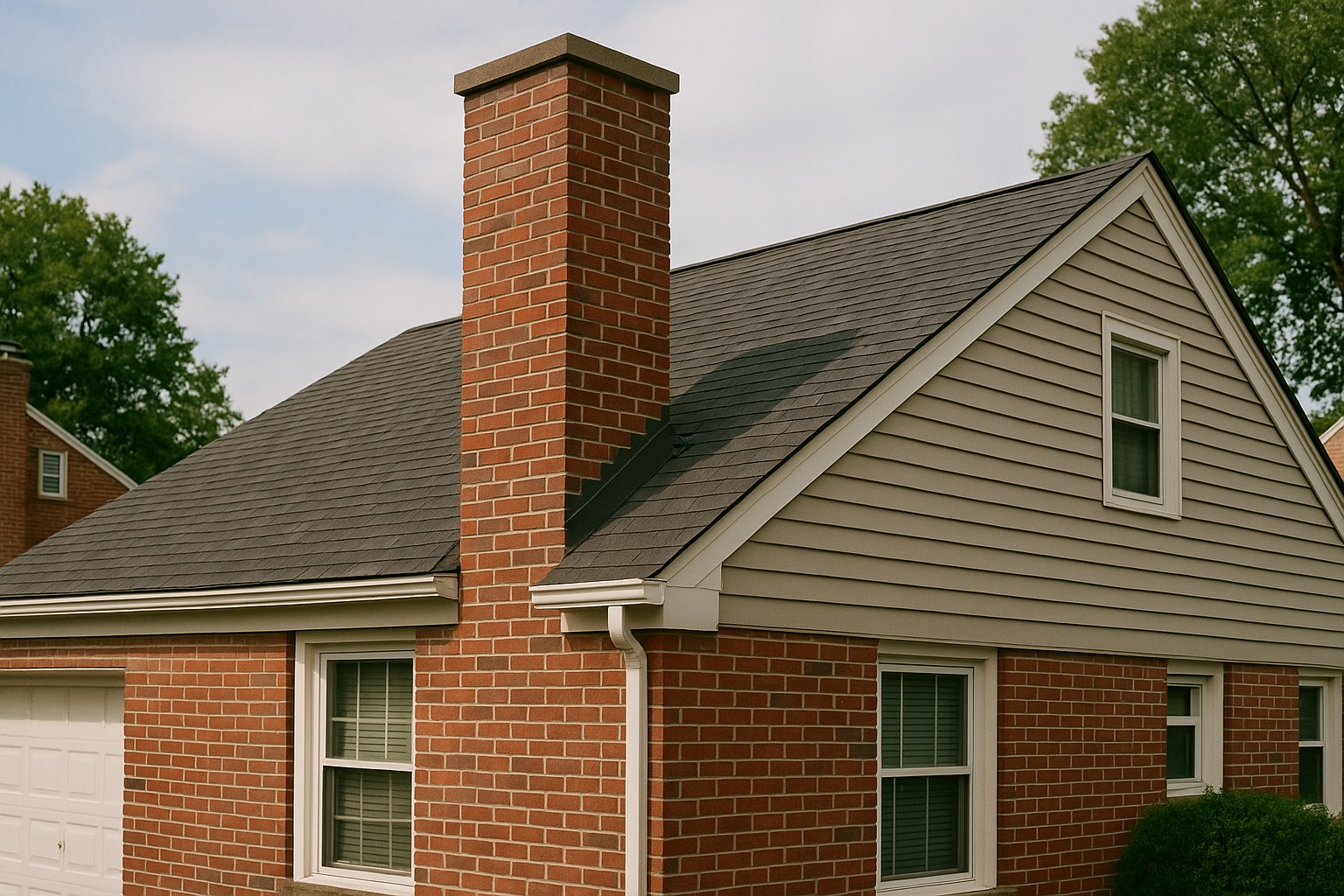
If water shows up on a ceiling near your fireplace, the chimney is the likeliest source on the whole roof — and in most Cincinnati homes the thing that failed is not the brick. It is the sheet metal where the brick meets the shingles. This guide covers the four places a chimney actually leaks, how to tell a roofing defect from a masonry one before you call anyone, and why the masonry half of the job has a deadline this fall that the roofing half does not.
Start with when it leaks, not where
Before anyone gets on a ladder, write down the pattern. Timing narrows the diagnosis faster than a visual inspection, because a chimney leak is usually visible inside long before it is visible outside.
- Only in wind-driven rain from one direction. Water is being pushed past the counterflashing or straight through the face of the brick on the exposed side. A chimney that stays dry in a calm all-day soaker and drips in a squall is telling you the problem is on one elevation.
- In every rain, roughly in proportion to how hard it comes down. There is an open path — a lifted step flashing, a gap where the flashing meets the shingles, or a section that was never replaced when the roof was.
- Hours after the rain stops, or on a clear day following a wet week. The masonry is saturated and releasing water inward. That is an absorption problem, and no amount of flashing work will fix it.
- In cold weather with no rain at all. That is usually condensation inside an oversized or unlined flue, not a leak, and it belongs to a chimney professional rather than a roofer.
Photograph the stain each time and note the date and wind direction. Two or three data points will tell a contractor more than a guess about what “started recently” means.
1. Step flashing and counterflashing
Chimney flashing is a two-part system, and both parts have to be present. Step flashing is a series of L-shaped metal pieces woven into the shingle courses as they run up the side of the chimney. Counterflashing — the code calls it cap flashing — sits over the top of it and sheds water onto it. Ohio’s residential code requires step flashing to be not less than 4 inches high and 4 inches wide and to direct water away from the vertical sidewall, and requires base and cap flashing to be corrosion-resistant metal of at least 0.019-inch nominal thickness, installed per the manufacturer’s instructions (Ohio Admin. Code 4101:8-9-01, sections 905.2.8.1 and 905.2.8.3).
The code sets the metal and defers the method, and that is where most failures live. The durable way to terminate counterflashing is a reglet — a shallow slot cut into a mortar joint that the metal tucks into and is then sealed. The fast way is to run a bead of sealant along the brick face and call it done. Sealant has a service life measured in years; a mortar joint does not. If you can see a ridge of roofing cement or caulk smeared around the base of your chimney, the last person up there patched a symptom, and it is almost certainly the reason you are reading this.
Reflashing is a contained job. It is also the single most common fix we make on a roof leak that a homeowner assumed meant a new roof.
2. The cricket that was never built
A cricket is a small peaked structure built onto the up-slope side of a chimney to split water and send it around instead of letting it pond against the brick. It is not optional. Ohio requires a cricket where the chimney’s dimension parallel to the ridgeline is greater than 30 inches and the chimney does not intersect the ridgeline, and Table 1003.20 sizes it by roof slope — the cricket’s height runs from half the chimney width on a 12:12 roof down to one-eighth of it at 3:12 (Ohio Admin. Code 4101:8-10-01, section 1003.20). The same section requires the cricket-to-chimney intersection to be flashed and counterflashed like any other roof-chimney joint.
Thirty inches is not a large chimney. A double-flue chimney on a mid-century house in Blue Ash or Montgomery clears it easily, and plenty of them have no cricket at all — either the house predates the requirement or a re-roof went on without adding one. What you get instead is a flat shelf of shingles behind the chimney that holds leaves and grit, stays wet for days, and works water backward under the courses. If you are getting a quote for a full roof, ask directly whether a cricket is included; it is a line item that quietly disappears from cheap bids.
3. The crown, the cap and the height
The crown is the sloped slab across the top of the masonry. Ohio requires a concrete, metal or stone cap with a drip edge and a caulked bond break around the flue liners, sloped to shed water (section 1003.9.1). What a lot of older Cincinnati chimneys have instead is a mortar wash — mortar troweled flat across the top and feathered to the edge. Mortar is not a crown material. It cracks, the cracks open with each freeze, and water goes straight into the core of the chimney where it will show up somewhere unpredictable below.
The same section of code sets chimney height: at least 3 feet above the highest point where the chimney passes through the roof, and at least 2 feet higher than any part of the building within 10 feet. Height is a draft and fire-safety rule rather than a leak rule, but it is worth checking while someone is up there, particularly on homes in Hyde Park and Oakley where a later addition or dormer changed what is within that 10-foot radius.
4. The brick and mortar themselves
Brick absorbs water. That is normal and fine as long as it dries out. It stops being fine when the joints have eroded below the face of the brick, when a previous repair used a mortar harder than the original, or when the chimney simply never gets sun. A saturated chimney going into a freeze is how faces spall off, and once a face has popped, the exposed interior absorbs faster than the face did.
Open joints, missing mortar, white efflorescence staining and brick faces that have flaked away are all masonry findings. None of them are fixed with flashing. If you have them and you also have a leak, you have two jobs.
So which trade do you call?
A short rule that holds up most of the time:
- Brick above the roof line is sound, joints are tight, crown is intact, and the water track starts at or below where the chimney meets the shingles. That is a roofing job. Reflash it.
- Crown is cracked, joints are open, or faces are spalling. Mason first, roofer second — in that order. Flashing installed against masonry that is about to be rebuilt gets torn out and paid for twice.
- Both. Common on any chimney that has gone twenty years without attention. Get both scoped in one visit so the sequencing and the two quotes make sense together.
One thing worth being blunt about: a roofer who quotes chimney masonry, or a chimney company that quotes a full reflash, is quoting outside their trade. Ask who is actually doing the work. Our pre-signature checklist for Cincinnati roofing projects covers how to verify that before you sign anything, and the roofing glossary defines the flashing terms if a quote uses them loosely.
Why the masonry half has a September deadline
Flashing is metal and fasteners. It can be installed in the cold, which is why emergency roof repairs are possible year-round. Mortar, crown patch and sealant cannot, and that is the part of the calendar people miss.
The Brick Industry Association treats anything below 40°F as cold-weather masonry construction, requiring specific provisions, and warns that mortar with a water content above 6 percent will likely be damaged by the expansion of that water if it freezes — with protection required for 24 hours after the work is finished (BIA Technical Notes 1). Fresh mortar that takes a freeze before it has cured does not simply cure later. It cures weak.
For Cincinnati, the National Weather Service’s 1991–2020 normals put the first 32°F freeze at Lunken on October 25, with a 10 percent chance of it arriving as early as October 12 and 90 percent likelihood by November 5 (NWS Wilmington fall frost and freeze climatology). Working backward from mid-September, that is roughly five to six weeks of dependably workable conditions, minus whatever the schedule of a good mason already looks like in the busiest month of his year. Book the masonry now and the flashing can follow whenever it follows.
Permits: the City and the suburbs are not the same
Inside Cincinnati city limits, the Department of Buildings and Inspections exempts a specific list of work on 1-, 2- and 3-family dwellings, and that list includes “gutters and downspouts (includes valleys, flashings, soffits, fascia and associated trim work)” along with roof coverings of no more than two layers (City of Cincinnati, Do I Need A Permit?). Reflashing a chimney lands squarely in that exemption. Rebuilding chimney masonry does not — that is building repair, and it needs a permit. If the property carries a historic designation, a Certificate of Appropriateness from the Urban Conservator is required before any work begins, permit or not.
That exemption applies in city neighborhoods like Hyde Park and Oakley. It does not carry past the city line: Blue Ash, Montgomery, Madeira and West Chester are separate municipalities running their own building departments, and their thresholds differ. If you are outside Cincinnati, one phone call to your own municipality before the crew is scheduled is cheaper than a stop-work order. We cover this ground across Greater Cincinnati and can tell you which set of rules applies to your address.
What chimney leak repair costs in Cincinnati
National ranges as of 2026, useful for sanity-checking a quote rather than budgeting to the dollar: chimney flashing repair or replacement runs $300 to $1,800; a minor crown repair $200 to $700, with full crown replacement $1,000 to $3,000; repointing $700 to $3,000 for most chimney projects; a chimney cap $200 to $850 installed; and a partial rebuild $1,000 to $5,000 or more (HomeGuide chimney repair cost data). A basic inspection is $100 to $300.
Two things move a quote outside those bands. Rotted decking or framing under the leak is extra, and it is not discovered until the flashing comes off. And if the chimney flashing has failed on a roof that is already near the end of its life, reflashing buys you a few seasons at best — worth pricing against a Cincinnati roof replacement before you spend twice.
Where to start
Get the chimney looked at while the weather still allows the masonry work, and get the flashing and the brick assessed in the same visit so the two quotes arrive in the right order — call Sterling Exteriors at (513) 685-8055 and we will tell you which half of the problem is ours.