
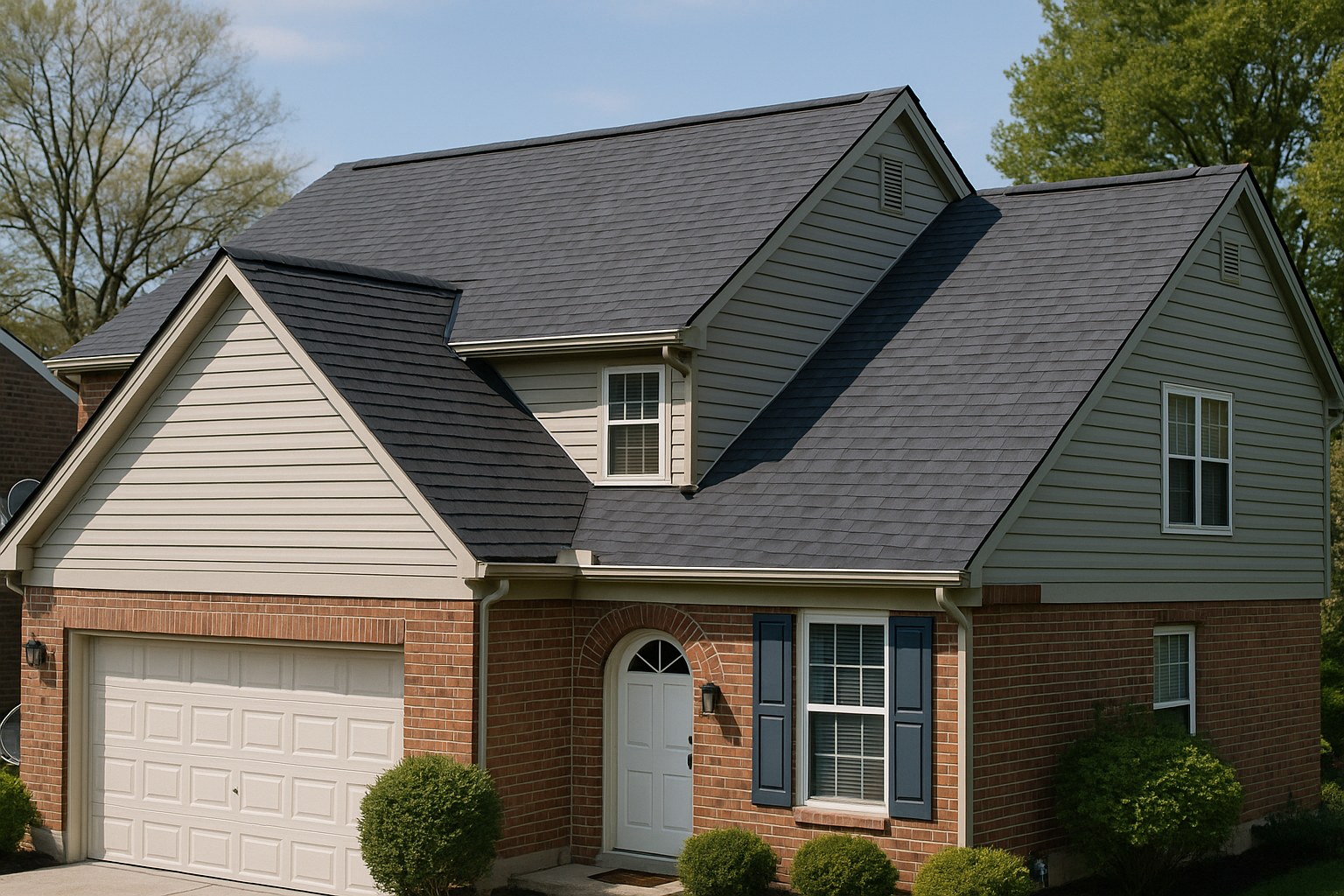
If you are weighing a new roof now versus waiting until spring, the deadline that actually matters is not a date on the calendar. It is the surface temperature of your shingles and how much direct sun each slope gets in the days after the crew leaves. Miss that window and you end up with a roof that is fully installed but not sealed, and an unsealed roof is the one condition your shingle warranty specifically will not cover.
Here is how the timing works in Greater Cincinnati, what to ask for if your install lands in cold weather, and which projects can honestly wait until March.
The deadline is a temperature, not a date
Architectural asphalt shingles are not finished when the last nail goes in. Each shingle carries a factory-applied adhesive strip that only bonds to the course below it once the sun warms the surface. Until that bond forms, every tab on your roof is held by its nails alone.
GAF’s technical guidance on temperature extremes puts the comfortable installation range above 40 degrees Fahrenheit, and notes that sealing time varies with the slope of the roof, its orientation, and how much sun and heat it gets. That last part is the part homeowners miss. Air temperature is a rough proxy. Sun exposure on that specific slope is the real variable.
For the Ohio Valley, the National Weather Service office in Wilmington publishes the 1991 to 2020 normals for our first fall freeze. At both Lunken Field and CVG, the normal first 32-degree freeze lands on October 25, with a ten percent chance of it arriving as early as October 12 and a ninety percent chance it has happened by November 5. Those dates do not mean sealing stops. They mark the point where you stop being able to count on it.
What an unsealed roof actually costs you
This is the part that turns a scheduling question into a money question. The GAF Shingle and Accessory Limited Warranty is explicit: self-sealing shingles must be exposed to warm, sunny conditions for several days before they completely seal, and before sealing occurs they are vulnerable to blow-offs and wind damage. It goes further. Shingles that are not exposed to direct sunlight or adequate surface temperatures may never seal, and failures under those conditions are described as the nature of self-sealing shingles rather than a manufacturing defect. They are not covered.
Read that against an Ohio Valley December. A roof installed in late November on a shaded slope can sit unbonded through December, January, and February, which is exactly when our straight-line wind events show up. The shingles are new. The workmanship may be perfect. The wind coverage still does not apply, because the adhesive never activated.
If you are choosing a shingle system partly for its wind rating, it is worth understanding how GAF warranty coverage is structured before you sign anything for a late-season install.
Your north slope is the problem, not your whole roof
Roofs do not seal as one unit. South and west-facing slopes catch low winter sun and frequently bond within a few days even in November. North-facing slopes are a different story, and slopes shaded by mature trees are the worst case of all.
That is a real pattern on the wooded lots in Indian Hill and along the older sections of Anderson Township, and on the tree-lined streets in Madeira where the canopy has forty years on the houses. A north slope under that kind of shade can go from November to March without a single day of direct sun on the shingles.
So when you get a late-season estimate, ask a specific question: which slopes does the contractor expect to self-seal, and which ones are they planning to hand-seal? A roofer who has worked these neighborhoods will answer that without hesitating. One who says the whole roof will be fine has not looked at your orientation.
Working the schedule backward from mid-October
If you want the adhesive to do its own work rather than paying someone to do it by hand, the practical target is tear-off completed by the middle of October. Working backward from there, a typical project looks like this:
- An inspection and a written, itemized estimate. Budget a week or two, longer in the weeks right after a storm.
- A permit, if your jurisdiction requires one. Cincinnati proper handles reroofs differently than several of the surrounding municipalities, which is worth checking before you assume, and we covered which permit rules apply to your address in detail.
- Color and product selection, plus material ordering.
- The install itself, which runs one to two days on most single-family homes in Loveland or West Chester.
- Several warm, sunny days afterward. This is the step nobody schedules, and it is the one that determines whether the roof is finished or merely installed.
In practice the constraint in September and October is rarely the weather. It is crew availability. Fall is the busiest replacement stretch of the year here, so the calendar fills from the front. If the number is what is holding you up, get clear on what a replacement actually costs in this market early, so financing conversations do not eat two of your remaining weeks.
If your install lands in November or later, get this in writing
Cold-weather installation is legitimate work. Crews do it every winter and do it well. What separates a good cold-weather job from a bad one is that the good one accounts for the adhesive never activating on its own. Ask for these specifics in the contract, not as a verbal assurance:
- Hand-sealing. Each tab spot-sealed with asphalt roof cement per the manufacturer’s instructions. GAF states directly that hand-sealing may be required when it is too cold to activate the adhesive promptly.
- Warm storage. Shingles held at roughly 70 degrees for at least 24 hours before they go up the ladder. Cold shingles crack and delaminate when bent, and a bundle that sat overnight on a frozen driveway is not the same product.
- Fasteners placed in the common bond, the double-layer portion of the shingle. GAF recommends this specifically to limit blow-off during the stretch before the adhesive takes hold.
- The ice barrier done to code. Section 905.1.2 of the Residential Code of Ohio requires an ice barrier running from the eave edge to a point at least 24 inches inside the exterior wall line. On a house with deep overhangs or a low-slope porch roof, meeting that measurement takes two courses of membrane, not one. Measure it against your own overhang rather than assuming one roll does it.
- A layer check. Ohio does not allow a new covering to go over two or more existing layers. If your roof already carries two, this is a tear-off, and any bid that quotes an overlay is wrong before it starts.
- A spring return visit. A written commitment to come back in April and check the shaded slopes for tabs that never bonded, at no charge.
That last item is the cheapest insurance in the whole contract. It costs a contractor an hour and it catches the exact failure mode the manufacturer has already told you it will not pay for.
What can honestly wait until spring
Not everything needs to happen in the next six weeks, and a contractor who tells you otherwise is selling rather than advising. Siding, outdoor living projects, and a full replacement on a roof that is aging but sound will all be there in March, generally on a calmer schedule and without the sealing question hanging over them.
What does not wait is anything already letting water in. An active leak, exposed decking, or a section of missing tabs will do more damage over one Ohio Valley winter than it did all summer, because freeze-thaw cycling drives moisture into every gap it finds and then widens it. If you are unsure which category you are in, the signals that separate a repair from a replacement are usually visible from the ground.
August storm damage runs on a separate clock
The storms that moved through on August 11 and 12 knocked out power to more than 180,000 Duke Energy customers across Hamilton, Clermont, and Kenton counties and left wind and tree damage scattered across the region. If your roof took hits in that system, the insurance timeline is independent of the sealing timeline and generally shorter.
Document the damage and open the claim now even if the repair itself lands in November. Waiting until you have a contract in hand is how a covered loss turns into a denied one, and the storm damage claim process has its own sequence worth understanding before you call your carrier.
The short version
Book a replacement now and the sun does the sealing for free. Book it in late November and you are paying for hand-sealing, or gambling a wind warranty on a north slope that may not see direct sun until spring. Neither is wrong. They are just different prices, and you should know which one you are buying.
If you are not sure which side of that line your house falls on, a slope-by-slope look takes about half an hour and settles it; call Sterling Exteriors at (513) 685-8055 and we will tell you plainly whether this is a September job or a March one.