
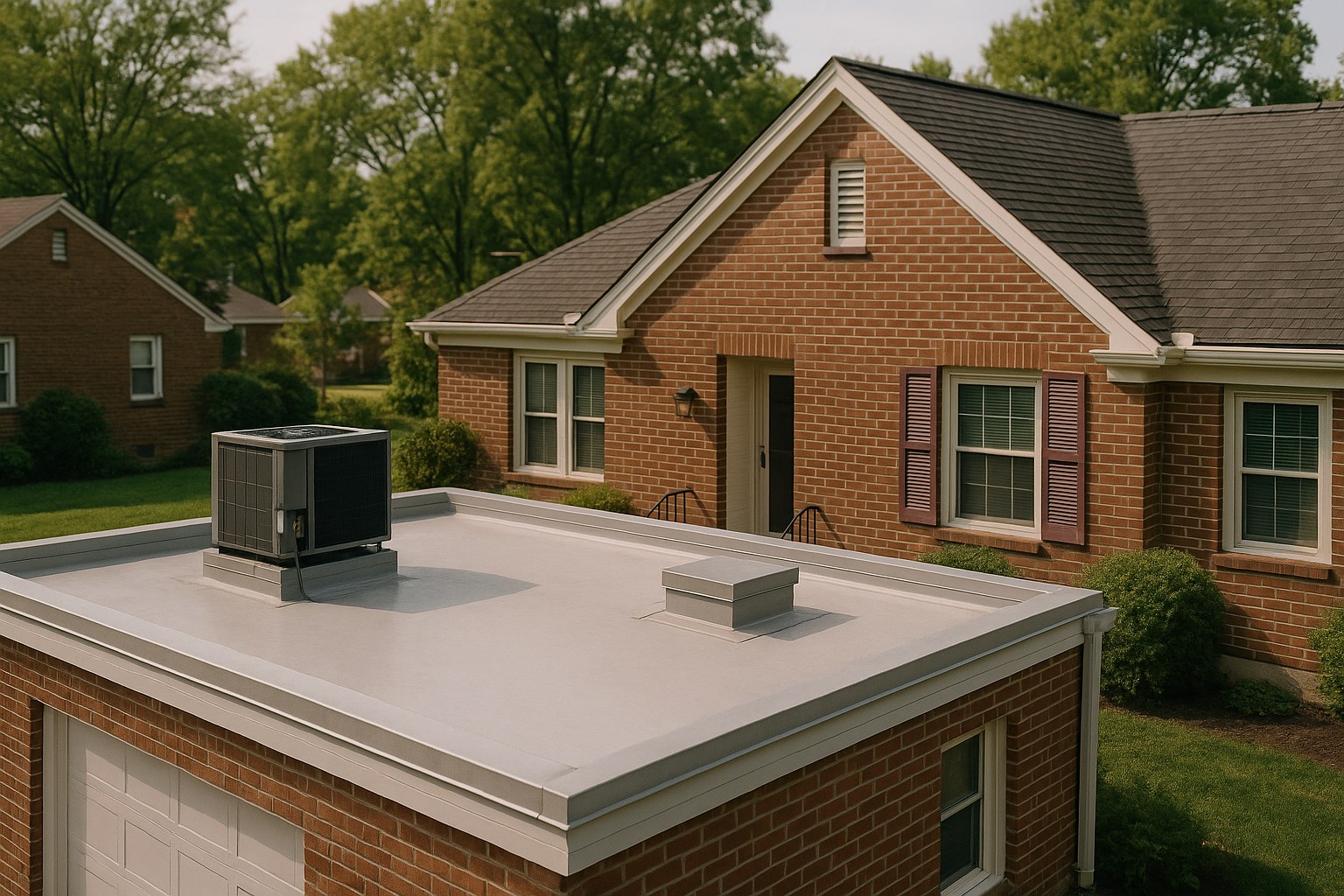
If you are responsible for a low-slope roof anywhere in Greater Cincinnati, the next four weeks decide whether you take a phone call about a ceiling stain in January. Leaves come down, they settle in the drain sump, and water that should be gone in two days sits there until it freezes. This is a drainage article and nothing else: what to look at this month, what the numbers actually are, and which findings are housekeeping versus a repair you need to schedule before the weather closes in.
The code already assumes your drains are blocked
Most building owners treat a plugged roof drain as bad luck. The code treats it as the expected condition. As of 2026, Section 1101.7 of the International Plumbing Code requires that roofs be designed for the maximum possible depth of water that will pond on them, and it directs the designer to assume that all primary roof drainage is blocked when working out that depth. The engineering review published by WoodWorks on ponding in low-slope roofs quotes that language directly.
That assumption is why your building has secondary drainage. Where a parapet or similar perimeter construction would trap water if the primary drains back up, the International Building Code requires overflow drains or scuppers, with the inlet flow line set 2 inches above the low point of the roof. An overflow drain has to match the size of the primary drain. An overflow scupper has to be three times the drain size, with an opening at least 4 inches high. Atlas Roofing’s summary of the 2021 and 2024 code provisions lays out both options.
Two things follow from that, and they are worth knowing before you call anyone. First, a couple of inches of water sitting against a parapet is not automatically a defect. It can be the secondary system doing precisely what it was designed to do while the primary drain is plugged. Second, and more serious: if the overflow scupper has been screened shut, painted over by a maintenance crew, or packed with the same leaves that took out the drain, the backstop is gone. There is then nothing between a blocked drain and a roof holding every inch of rain that lands on it.
What an inch of standing water actually weighs
Water weighs 5.2 pounds per square foot for every inch of depth. WoodWorks states the figure plainly and notes that engineers commonly round it to 5 psf.
Put that against a real roof area. A 40 by 60 foot bay is 2,400 square feet. Two inches of water standing across it is roughly 25,000 pounds, about 12.5 tons, arriving on top of whatever snow load the structure was designed for. On a single-ply field with a shallow low spot, two inches is not an unusual depth.
The reason ponding gets worse rather than staying the same is that the load and the shape feed each other. Water collects in a low spot, the deck deflects under the weight, the low spot deepens, and it collects more water next time. WoodWorks makes the point that a roof meeting the minimum slope in its undeflected state can still drain badly once dead-load deflection occurs, which matters most on long spans where deflection can exceed an inch. For context, Section 1507 of the building code sets a minimum roof slope of one quarter inch per foot or greater, with the exact figure depending on the roof covering.
You do not need to run any of these calculations. You need to notice that the water shows up in the same place every year and that the stain ring is wider than it was last October.
The 48-hour test anyone can run
There is a simple field test that separates a drainage problem from normal post-rain wetness. Carlisle’s owner’s manual for single-ply systems states that good roofing practice requires water to drain from the roof, and that ponded water should evaporate within 48 to 72 hours after a rainfall. It names debris as a direct cause of inhibited drainage.
So after the next soaking rain, note the date and time. Go back up at the two-day mark and again at three days. Anything still holding water at 72 hours is a drainage defect, not weather. Photograph it with the timestamp on, and keep the photo. That record is worth more than your memory of it when you are discussing the roof with a contractor or an adjuster six months later.
Those photographs also do real work later. Low spots that fail the 48-hour test are the ones worth designing out at replacement, and three autumns of the same puddle is a much easier case to make than a description. Which membrane you are standing on changes the repair options as well, so it helps to know whether you have a TPO, EPDM, or modified bitumen system before the conversation starts.
Your warranty has deadlines you have probably not read
This is the part that costs money quietly. Carlisle’s sample system warranty requires the owner to give written notice of any leak within thirty days. It excludes failure by the owner to use reasonable care in maintaining the roof, with that maintenance defined by the manufacturer’s own care guide. And it tells the owner to inspect the roof at least every six months, preferably spring and fall, plus immediately after any weather event involving heavy rain, high wind, or hail.
It also expects the owner to keep inspection logs, rooftop traffic logs, and invoices for work done on the system. Terms differ between manufacturers and warranty levels, so read your own document rather than this summary.
The National Roofing Contractors Association gives the same cadence independently. Its technical guidance in Professional Roofing recommends inspection at least twice a year, preferably spring and fall, and after severe weather, with special attention to valleys, gutters, and roof drains where debris tends to collect and limit drainage.
Read together, the autumn inspection stops being good advice and starts being a condition of coverage. If you have no documentation and a seam fails in February, the gap in the file is yours to explain. Scheduling a commercial roof maintenance program is partly about the roof and partly about having the paperwork when you need it.
Cincinnati’s actual calendar
The deadline here is not a date on a maintenance contract, it is the first hard freeze. According to the National Weather Service office in Wilmington, working from 1991 to 2020 normals, the normal first 32 degree reading at both Lunken Airport and the Cincinnati and Northern Kentucky airport is October 25. One year in ten it arrives as early as October 12, and nine years in ten it has happened by November 5.
Water that is still sitting on the roof when that happens stops behaving like water. It freezes in the low spot, expands, and works at seams, drain flashings, and scupper sleeves. A clogged drain in September is a housekeeping item. The same clog in late November is a membrane problem.
Leaf drop around here does not happen all at once either, which is why one visit is not enough. An early thinning comes first, then the heavy drop later in the month once nighttime temperatures fall. Plan two clearings rather than one: the first after the leaves start coming down in earnest, the second in late November once the trees are bare. One clearing in early October leaves the roof to collect the bigger half of the leaf load with nobody watching.
Risk is not spread evenly across the area, either. The office and flex buildings along the Blue Ash and Montgomery corridors tend to have large single-ply fields with mature trees right at the property line, putting leaf load directly over the drains. Loveland’s older downtown buildings fail differently: small parapets, interior drains, and leader lines running through occupied space, so a backup shows up as a ceiling stain rather than a puddle anyone can see. Light industrial buildings in Newtown often have the long spans where deflection matters most, and the retail boxes in Oakley carry big membrane fields served by few drains, so losing one takes out a lot of drainage at once.
A drainage-only walkthrough
None of this requires equipment beyond a bucket and a pair of binoculars. If you are not comfortable on the roof, send someone who is, or skip to the ground-level checks.
- Lift the strainer dome off each drain, clear the sump by hand, and put the dome back. Missing or broken domes are common, and without one the leaves go straight into the leader line, where clearing them is a plumber’s job rather than a janitor’s.
- Clear a three-foot radius around every drain. Debris does not have to be in the drain to block it; a mat of wet leaves nearby will migrate in the next downpour.
- Check every scupper, including the overflow scuppers. These you can usually inspect from the parking lot with binoculars, which makes it the easiest check on this list and the one most often skipped.
- Look at where the water goes after it leaves the roof. Blocked or disconnected gutters and downspouts back water up onto the roof edge and dump it against the foundation.
- Walk the perimeter at the base of the parapet. Leaves collect in the corners first, and that is where the membrane turns up and the flashing is most vulnerable.
- Check rooftop equipment curbs and condensate lines. A condensate line discharging onto the membrane keeps one spot permanently wet, which is a slower version of the same problem.
- Write down what you found and the date, with photographs. This is the log your warranty asks for.
Housekeeping, repair, or design
Sorting findings into three buckets keeps the budget conversation honest. Leaves in the sump, a loose strainer dome, a debris mat at the parapet corner: housekeeping, and your own staff can handle it.
Water that fails the 48-hour test in the same place every year, a drain that runs slowly after it has been cleared, a soft or spongy area underfoot, or an interior stain below a leader line: these need someone to open the assembly and look. Wet insulation does not dry out once it is saturated, so the longer a slow leak runs the more of the roof you end up replacing rather than repairing. If the stain is active and spreading, that is the point to call for emergency roof repairs instead of waiting for the next scheduled visit, and tracing where a roof leak actually originates is rarely a matter of looking straight up from the stain.
Too few drains for the roof area, no positive slope to the drains you have, or a low spot the structure has settled into: that is a design problem. It does not get solved with a bucket, and the right time to fix it is when the commercial roof is being replaced, with tapered insulation and additional drainage designed in.
Permits and who actually has jurisdiction
One local detail catches owners out. The permit exemptions people know from residential re-roofing do not carry across to commercial buildings. The City of Cincinnati’s commercial permit guide states that a commercial building permit is required for most non-residential construction, including new construction, remodels, additions, tenant improvements, and change of use. Clearing a drain is maintenance and nobody needs a permit for it, but cutting in a new drain, adding scuppers, or re-roofing a section is work worth confirming before it is scheduled.
Jurisdiction is the other half of that. Oakley is a City of Cincinnati neighborhood, so the city’s building department has it. Blue Ash, Montgomery, Loveland, and Newtown are separate municipalities with their own building departments and their own submittal requirements. A contractor who works across the county should know which counter your building belongs to, and it is a fair question to ask before you sign anything.
If you want the drainage checked properly before the first freeze, a drain and scupper inspection takes an hour or two on most buildings and is the cheapest thing you will do for the roof all year. Sterling Exteriors can be reached at (513) 685-8055.