
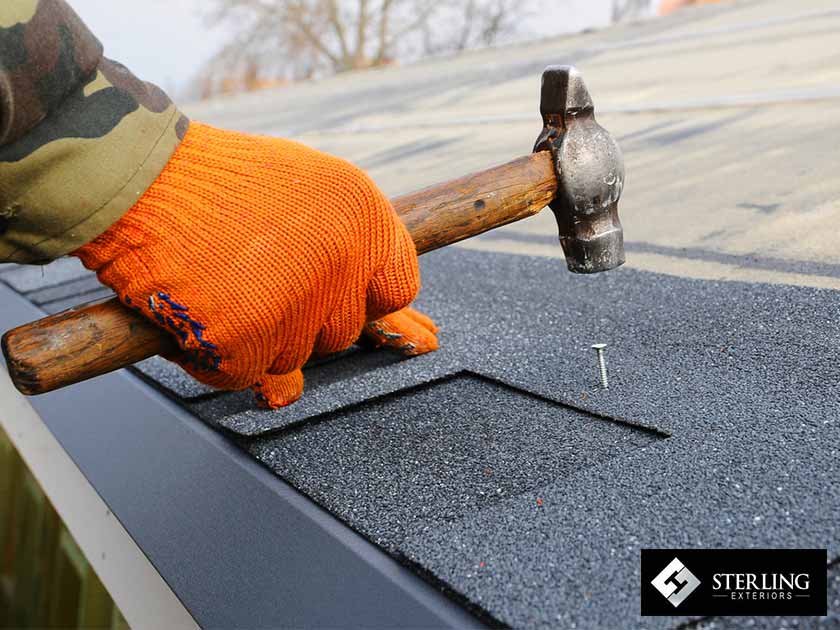
Some roof work belongs to you. Clearing gutters from a stable ladder, checking the attic after a hard rain, photographing storm damage before anyone touches it, walking the yard for blown-off shingle tabs after a spring storm line moves through Anderson Township or Milford: all reasonable, all useful, all done with both feet low or on the ground. What does not belong to you is anything that requires you to stand on the roof deck and put a fastener through a shingle. This guide draws that line precisely, explains what actually goes wrong when a homeowner crosses it, and corrects the one piece of advice most roofing blogs get wrong about warranties.
The short version: what a homeowner can safely handle
These four jobs are genuinely yours, and doing them well prevents most of the repairs people end up attempting:
- Cleaning gutters and downspouts from a ladder footed on level ground, never from the roof edge. In Greater Cincinnati the critical window is late October into November, when the oak and maple load comes down all at once.
- Inspecting the attic with a flashlight during or right after a heavy rain. Staining on the underside of the sheathing, damp insulation, or daylight around a vent boot tells you more than standing on the shingles ever would.
- Surveying the roof from the ground with binoculars. Lifted tabs, granule piles at the downspout outlet, a bent or displaced ridge cap, rusted flashing at a chimney: all visible from the driveway.
- Documenting damage with dated photographs and keeping every receipt and estimate in one folder.
Everything past that line, including a single replacement shingle, involves working at height on a sloped surface, fastening into a system with specific published requirements, and accepting the consequences if the repair is wrong. Our roof repair service page covers what that work involves on a typical Cincinnati home.
The ladder is the real hazard, not the roof
The injury data is not about roofers. It is about homeowners. A study in the American Journal of Preventive Medicine, Ladder-Related Injuries Treated in Emergency Departments in the United States, counted an estimated 2,177,888 ladder-related injuries treated in U.S. emergency departments across sixteen years, an average of roughly 136,118 a year. Of the cases where a location was recorded, 97.3 percent happened in non-occupational settings, meaning homes and farms rather than job sites. Fractures were the single most common injury at 31.5 percent, and the annual count rose by more than half over the study period.
Professional crews work under rules written specifically because this work hurts people. OSHA requires that “each employee engaged in residential construction activities 6 feet (1.8 m) or more above lower levels shall be protected by guardrail systems, safety net system, or personal fall arrest system,” and applies the same six-foot trigger to work on steep roofs. None of that applies to you on your own house. There is no anchor point on a typical Cincinnati roof unless someone installs one, no toeboard, and no second person on the ground.
Local housing stock makes this worse than the national average. The older neighborhoods have steep, tall roofs built long before anyone thought about a service walk. A gable end in Indian Hill or an 1890s Milford farmhouse frequently puts the eave twenty-five feet up over sloping ground, which means the ladder is already set on a grade before you climb it. Newer subdivisions in Mason and West Chester are gentler, but a 6-in-12 pitch is still steep enough that a granule under a shoe behaves like a ball bearing.
One more exposure people miss: if you pay an uninsured handyman to go up instead, and he falls, you may be the party with the deepest pocket and the only applicable policy. Ask any contractor for a current certificate of insurance naming general liability and workers’ compensation, and confirm it with the carrier rather than the contractor.
What “it voids your warranty” actually means
Nearly every article on this subject says that touching your own roof voids the manufacturer’s warranty. That is not what the document says, and the real answer matters more.
The GAF Shingle and Accessory Limited Warranty excludes, under its “What Is Not Covered” heading, damage from “improper fastening of your shingles or accessories or application not in strict accordance with GAF’s printed application instructions, if the improper installation was the cause of the damage.” It separately excludes damage from “impact of traffic on the roof or foreign objects.” Read that carefully. The warranty is not switched off the moment you set foot on the roof. What happens is narrower and, in practice, harder to argue with: whatever your repair caused is not covered, and neither is what your feet did to the surrounding shingles on a hot August afternoon when the asphalt was soft.
The coverage that genuinely disappears is workmanship. Material warranties cover the shingle. Workmanship coverage, the part that pays to correct an installation error, only exists on the enhanced system warranties, and those are written exclusively through certified contractors. As a GAF Certified Elite installer, Sterling Exteriors can register that coverage on a qualifying system; a homeowner cannot add it later, and no amount of paperwork after the fact converts a self-performed repair into covered work. Our GAF warranty page lays out which tier attaches to which installation.
The four repairs that generate the expensive callback
These are the specific errors we find when we open up a homeowner repair, in rough order of how often they show up.
Nails driven above the nailing zone
Architectural shingles have a narrow reinforced strip where the fastener is supposed to land, and it is not obvious from the top of the shingle. Set the nail an inch high and it misses the top edge of the course below entirely, so the shingle is held by one layer of asphalt instead of two. The roof looks perfect. It stays looking perfect until a straight-line wind event in March or April lifts that course and takes the ones above it. Overdriving is the same failure by a different route: a nail head pulled through the mat leaves a hole under the next course with nothing sealing it.
Roofing cement applied as a leak cure
A tube of black plastic cement will stop a drip for one season. It also traps moisture against the deck, becomes rigid, and cracks through the first full Ohio Valley freeze-thaw cycle, usually somewhere you cannot see. Worse, it conceals the evidence. When the leak reappears, the actual source, which is very often a failed pipe boot or step flashing rather than the shingle itself, is now buried under a patch that has to be chipped off before anyone can diagnose anything. If you have an active leak, our roof leak repair page explains how the source is traced.
A new shingle laid over the problem
Water intrusion is almost never a shingle problem. It is a flashing problem, a valley problem, a fastener-penetration problem, or a ventilation problem showing up as condensation. Replacing the visibly damaged shingle without lifting the courses above it to find where the water actually enters means the repair is aimed at a symptom. Meanwhile the deck underneath keeps getting wet, and wet sheathing delaminates quietly for a year or two before the roof starts to feel soft underfoot.
A repair made too late in the year to seal
This one is seasonal and it is relevant right now. Asphalt shingles bond by means of a heat-activated sealant strip that needs sun and surface warmth to set. The Asphalt Roofing Manufacturers Association’s cold weather installation guidance notes that “sealing time will vary depending on the slope of the roof, its orientation, and the amount of sun and heat exposure,” warns that shingles handled in the cold “may crack, or in severe cases, break apart,” recommends storing them indoors to keep them warm before application, and directs that shingles “can be hand-sealed with an approved asphalt roofing cement or other adhesive acceptable to the shingle manufacturer” when conditions require it.
The practical consequence for Cincinnati: a shingle you set on a north-facing slope in late October may never reach sealing temperature before the first freeze, and an unsealed shingle is a loose flap waiting for the first winter wind. Professional crews hand-seal deliberately in that window. Most homeowners do not know it is required, because nothing about the repair looks unfinished.
Nobody is going to inspect your work, and that cuts both ways
The City of Cincinnati’s permit guide lists roof coverings of no more than two layers among the projects that do not require a building permit on one-, two- and three-family detached dwellings, alongside siding replacement and like-for-like window replacement. Gutters, downspouts, valleys, flashings, soffits and fascia are on the same exempt list.
People read that as permission. What it really means is that no inspector will ever look at the work. A miss-nailed course or a patched-over flashing detail does not get caught in the following weeks; it gets caught two or three years later, either by a buyer’s home inspector during a sale in Madeira or by an insurance adjuster standing on the roof after a hail event and deciding which damage is storm-related and which is pre-existing. Note also that the exemption is a City of Cincinnati rule. Anderson Township, Milford, Mason, Indian Hill and Loveland are separate municipalities with their own requirements, and a locally designated historic property can carry review obligations even where no building permit is needed.
If a storm caused it, stop before you touch anything
This is the situation where a DIY repair does the most financial damage, and the sequence matters. Photograph everything from the ground first, with dates. Report the loss to your carrier before you make any change beyond emergency measures needed to prevent further damage. A temporary tarp to keep water out is reasonable and generally expected; a permanent repair is not, because you have just altered the evidence the adjuster needs to evaluate.
Adjusters routinely separate storm damage from wear and from prior repair work, and a homeowner patch made before the inspection is the easiest thing in the world to classify as the latter. Our storm damage and insurance claims page walks through the documentation sequence, and if water is actively entering the house, that is what emergency service is for.
What to do this month instead
Mid-September is the right moment for the homeowner half of this work, before the leaf load arrives and while there is still enough sun on the roof for any professional repair to seal properly. Clear the gutters and confirm the downspouts discharge away from the foundation. Go into the attic with a flashlight after the next real rain and look at the sheathing and the insulation. Walk the perimeter with binoculars and photograph anything that looks lifted, bare or displaced. Check the granule accumulation where the downspouts let out, since a sudden increase is a genuine signal. If any of it suggests the roof itself is near the end rather than in need of a patch, the signs you need a new roof are worth reading before you spend money on repairs.
If what you find needs someone on the roof, call Sterling Exteriors at (513) 685-8055 and we will put a certified installer on it while the weather still cooperates.